“Asking an AI three questions uses less energy than boiling your kettle for one second.”
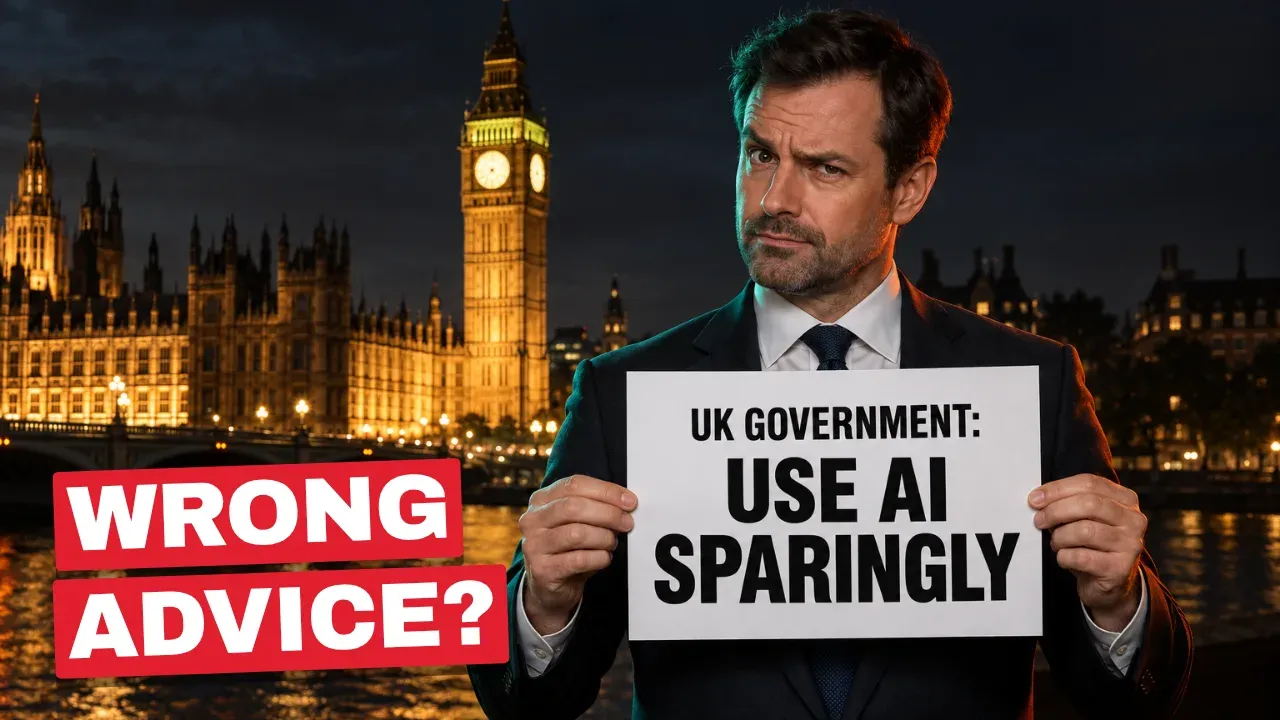
That’s the first line of a video I’ve just published, and I made it because of a piece of government advice. The UK government has told civil servants to use AI sparingly, to protect the environment. Check whether a spreadsheet could do the job first. Pick the smallest model that will do. Keep your prompts short. And you don’t need to say thank you.
Most of what you read about AI in the media sits at one of two extremes. It’s either going to transform everything, or it’s burning the planet down one data centre at a time. The risks are real, and I cover them below. But the opportunity side gets far less careful attention than it deserves, and when policy is written from only one side of the ledger, it can steer a whole country in the wrong direction. I think that matters for UK prosperity, and I wanted to make the case for the other half of the bill.
Why I care about this
AI isn’t a spectator sport for me. I run Scorchsoft, where we build apps, portals and AI products, and I still build AI tools myself: desktop dictation apps, an AI video editor and an agentic content engine among them. I test new models as they come out, because the differences between them change what’s worth building, and what it costs.
The video itself is an example. I researched it, scripted it, voiced it, animated it and rendered it with AI. But I’m just as interested in the other side of the question: the economics, the productivity figures and the rules that decide how organisations are allowed to use this technology. I’ve spent my career in business, and I care about how the UK grows. Advice like this sits right where those two interests meet.
A few terms, in plain English
Some of this is jargon, so here is what the words mean.
- Model. The AI system itself, such as ChatGPT’s GPT models, Google’s Gemini or Anthropic’s Claude. Bigger models tend to be more capable and cost more to run; smaller ones are cheaper and faster but make more mistakes.
- Prompt. What you type or say to the AI: a question, an instruction, a document to summarise.
- Tokens. The chunks of text a model reads and writes, roughly three-quarters of a word each. AI providers charge per token, so “counting the tokens” means counting the cost of the AI’s own work.
- Watt-hour (Wh). A unit of energy. A 60-watt bulb left on for a minute uses one watt-hour. A kettle boiling for a second uses a little under one.
- Data centre. The buildings full of computers that run AI models, along with everything else online.
- Deep thinking (reasoning). A mode where the model works through a problem step by step before answering. It gives better answers to hard questions, and uses more energy doing it.
- Agent. An AI that doesn’t just answer but acts: it plans a series of steps, uses tools such as a web browser or a code editor, checks its own work and carries on until the task is done.
- Caching. When an agent re-reads the same material, the provider can store it and charge a fraction of the price the second time.
- Productivity. How much an economy, a business or a person produces for each hour worked. It’s the main thing that decides whether wages and living standards rise over time.
The bill has two sides
Waste is waste, and the guidance has a point. Data centres already use about 1.5% of the world’s electricity, and that’s projected to double by 2030. Nobody should run a deep-thinking model to answer a question a calculator could.
But the advice only counts the tokens. It doesn’t count the person.
Google’s figures put a typical Gemini chat prompt at 0.24 watt-hours: under nine seconds of television, and 33 times less than a year earlier. Now look at the other side. In a government trial, 20,000 civil servants said AI saved them 26 minutes a day. A Department for Work and Pensions study with a comparison group found 19 minutes. Another, at the Department for Business and Trade, found no clear gain. So the honest conclusion is to measure the minutes, because they vary.
Take the 19 minutes. As I put it in the video:
“19 minutes of laptop and screen is about 16 watt-hours. Sixty-odd prompts. Or, in proper British units, a sixth of a kettle.”
The laptop doesn’t switch off when you finish early, but you get more done for the same energy, so each task costs less. In money, the case is even clearer. The typical UK worker earns about 33p a minute, and a top model costs about a penny for a quick question. Save two seconds, and it has paid for itself.
The smallest-model advice can also backfire. Squeeze too hard and you get a wrong answer, so you ask again, and again, and then you do it yourself. Now you’ve paid for the tokens and the time.
As for thank you: saying it to your AI every working day for a year uses less energy than boiling the kettle once. We’re British. It’s load-bearing.
Cheaper and more capable every year
The guidance also treats today’s costs as fixed, and they aren’t. Between 2022 and 2024, running a GPT-3.5-level model got more than 280 times cheaper, and the price is still falling. Budget models now roughly match the flagships of a few months earlier for a fraction of the cost. Price isn’t the same as energy, but it’s a rough clue to how much computing is involved.
That matters because the big shift is agents. They use far more tokens than a chat, but they can take on tasks that would take a person hours. METR, an independent research group that measures what AI can do, tracks the length of task an AI can complete. It was about an hour in early 2025. The latest model it has measured manages around seventeen hours, which is past the edge of what METR’s tests can reliably measure, and the figure has been doubling roughly every four months.
A heavy day of agentic coding can use the energy of over a hundred kettles. So it had better save hours. Often it does. Sometimes it doesn’t, which is the point: measure the outcome, not the input.
The real bottleneck is the organisation
If the tools are this capable, why isn’t everyone seeing the gains? Usually it isn’t the model; it’s the organisation around it. In Microsoft’s 2026 survey of twenty thousand AI users, culture, managers and talent practices explained over twice as much of the reported impact as individual effort. Where managers made it safe to experiment, readiness was up to twenty points higher. Only about a quarter said their leadership was even aligned on AI.
“A brilliant tool is worth little to a team that isn’t allowed to use it.”
Much of this evidence comes from companies that sell AI, so treat it as a claim to test, not a verdict. But it matches what I see with clients. The technology is rarely what holds a team back. Permission, training and a clear owner usually are.
The downsides are real
I don’t want to pretend otherwise. In America, employment of 22 to 25-year-olds in the most AI-exposed jobs is down about a fifth against less-exposed jobs. That’s a pattern, not yet proof. Data centres now use almost a quarter of Ireland’s electricity. Google’s total emissions are up 81% since 2019, mostly from building and supplying data centres, even as each prompt got 33 times more efficient: cheaper often means more. People who trust AI more report thinking less critically, and a public database lists over two thousand court decisions involving made-up citations. Licences cost real money, and public services must get security and accountability right.
Most of these are reasons to use AI well, and to build cleaner power. Few are reasons to stop.
Why the policy matters
This is the part I care about most. The biggest risk isn’t on the energy bill. It’s falling behind.
Productivity compounds. Forecasts of AI’s boost run up to about a point and a half of growth a year. Grow just one point a year faster than your neighbours, and in twenty years your economy is over a fifth bigger. An IMF working paper finds the gains flow to the best prepared, and being rich isn’t the same as being ready. Britain starts behind: France produces 10% more per hour worked than we do, and Germany 20% more. AI could help close that gap, or widen it.
Skills are a big part of it. The IMF’s 2026 review of Britain found that more AI skills, together with halving regulatory barriers, could raise AI’s gains by two-thirds. Yet only one in five UK workers feels confident using AI at work, and those skills only come from practice. As the economist Richard Baldwin put it: AI won’t take your job; somebody using AI will.
The government’s own AI plan talks about mainlining AI “into the veins of this enterprising nation”. That’s the right ambition. But guidance heard as “use less” rather than “use well” risks a chilling effect. Managers read it as a signal to hold back, people stop practising, and a skills gap opens that compounds while other countries pull ahead.
What I’d like the guidance to say
Use AI efficiently. Pick the right model for the job. Skip the pointless prompts, and save deep thinking for work where it saves real minutes. But judge the outcome, not the prompt. Measure what AI makes possible, train people to use it well, and don’t let caution harden into a culture of avoidance.
“A prompt costs a fraction of a kettle. Falling behind costs far more.”
If you’re a leader working out where your organisation stands with AI, or you’d like me to talk to your team or your event about it, I speak on AI and business, from first steps to measuring the value. And yes, when we made the video, we asked a spreadsheet first. It said #VALUE!