Most teams I’ve worked with are busy. Far fewer are under control, and from the inside the two are easy to confuse. A full calendar, a long thread and a late night all feel like progress. Then a client asks a simple question (who is doing this, and by when?) and nobody can answer it cleanly.
That gap has a cost. I call it the drift tax, and it’s the title of the first chapter of my new book, The Control Standard: How to Own Outcomes, Reduce Surprises, and Become the Person Leaders Trust. It came out in July 2026 in print, ebook and audiobook. This post is the story of why I wrote it.
The problem that kept coming back
Anyone who has run a business or a project will know this pattern. You see the same pain happen again and again. So you add a signal, something that tells you when it’s happening. The pain still happens. So you add a mechanism: a process, a checklist, a documented way of working. And the pain still happens.
That’s when I realised the problem wasn’t missing information or missing process. It was behavioural, and more fundamental than either. If you want to solve it, you have to address it at that level. Only once the basic habit of keeping work under control is in place can anything else be built on top of it.
The moment it became obvious to me is a story I still find hard to believe. Some time ago we defined a new service offering at Scorchsoft. I spent a long time writing the contracts and creating all the documents, and then I delegated it. The first month it was supposed to happen for a particular customer, nothing happened. The person responsible had helped create the whole process, but they didn’t follow through and close the loop. We ended up in a heroic crisis meeting to put it right.
Then it happened a second time.
That was the point where I thought: something has to change. I was doing everything I could think of to address the situation, and it had happened again anyway.
How a wiki became a book
Working through that problem, I kept adding articles to our internal wiki, and eventually I noticed something. I’d been writing the same body of work for a couple of years, one article at a time, without seeing it as a whole.
When I write guidance for my team, I like to cite sources and make sure the recommendations are backed by evidence. So those articles were solid. But they sat in silos, and nobody could see how they connected. We could do a lot better than that.
So early this year I stitched them together into a book and went through the whole editing process. People assume the writing is the hard part. It isn’t. Getting the first draft down is the easy bit; the editing takes the most effort. When you write a short essay, you read it, read it again, and read it once more. A book is the same process over a much bigger piece of work, and it takes a lot of judgement to make sure all of it is right. Imagine how many times you reread your own book before it’s finished.
I put a burner under it because I wanted it to become part of the culture at Scorchsoft. I was already rolling these lessons out to the team, but I wanted everyone to understand the story behind them and how they connect.
That also made the project worthwhile before a single copy sold. Alongside the book we built controlstandard.tools, with materials that support the programme, including e-learning. We’ve rolled it out across the team. Even if nothing had happened with the book, those materials are useful to me and my business.
Then there were the conversations outside work. Friends, family and people I know in leadership roles all described the same problems. It doesn’t matter how big the business is: even big businesses are made of small teams, and small teams have the same problems. This needed to get out there.
What I noticed about the people I trust most
After more than sixteen years of shipping software for clients, I’d noticed something about the people whose work I trusted most. As I put it in the book’s opening note:
“They were almost never the ones who worked the hardest or held the most senior title. They were the ones whose work was easiest to trust under uncertainty.”
That kind of trust can be learned, which is why the book exists. Another line from it sums up the idea: “Seniority is earned by making work easier to trust.”
There’s a newer reason too. AI now handles a growing share of routine work, such as first drafts and summaries. That changes what people are paid for. In the book I put it this way: “carrying an outcome is the part of the work a person is uniquely paid for.” If a tool can do the task, your value is in owning what the task was for.
What’s inside
The core idea fits on a card. Work is under control when you’ve turned uncertainty into five control points:
- A named owner: the person carrying it.
- A dated next step: what happens next, and when.
- A decision date: when the open question gets settled.
- An escalation path: who hears about it if it starts to slip.
- A fallback: what happens if the plan doesn’t land.
None of these is clever on its own. The difference comes from having all five in place for the work that matters. Or, as the companion site puts it: “Busy is what effort looks like. Controlled is what effort produces.”
The book has ten chapters:
- The Drift Tax
- What Under Control Actually Means
- Ownership Is More Than Task Completion
- Executive Usefulness
- The Control Toolkit
- From Task Thinking to System Thinking
- Leading a System, Not Routing Tasks
- Coaching That Builds the Standard
- Turn Repeated Problems into System Improvement
- Closing: The Pocket Standard
The early chapters are about owning your own work. The later ones are about leading others, and about turning problems that keep coming back into systems so you fix them once.
Who it’s for
The book names its default reader as “the ambitious contributor or emerging manager — project manager, delivery lead, developer, account manager, operations specialist, or someone running a small team for the first time.” It works for experienced managers, founders and senior leaders as well, but I wrote it so that a manager could hand it straight to someone on their team. If you manage people, I hope it’s the book you wish your direct reports had already read.
The companion tools
The book is meant to be used on live work, so it comes with free tools at controlstandard.tools: the Drift Report diagnostic, the Pain Automation Score, the Pocket Standard as a PDF, an image library, an interactive course for each chapter and a team dashboard.
Why it takes discipline, in business and on the bench
People ask whether powerlifting has anything to do with this. It does, although the link is discipline rather than anything clever.
When you run a business, sometimes you have to show up even when you don’t feel like it, especially if you’re a leader. You build that discipline in sport. In the gym you show up every day and lift the weights, knowing each session is part of a longer journey. That consistency is what leads to performance.
Writing a book needs the same thing. It isn’t a small project if you do it properly. You get the dopamine hit of starting, and then it takes real grit to get it all the way across the line to publishing.
I think about it as a conflict between short-term and long-term goals. Why wouldn’t you just eat cake all the time? In the moment there’s no reason not to. It’s delicious and it makes you happy. The only reason to say no is that it conflicts with your long-term goal of being healthy. So you need a long-term goal that’s more compelling than the cake. For me, that was a team that works this way and a book that gets these ideas to people who need them.
The audiobook, and why I chose Graham Mack
Graham Mack narrated and produced the audiobook, and he was great.
I’d paid for audio production before, so I knew what to listen for. When you compare narrators, some recordings simply aren’t as good as others, and some people make more errors. Graham nailed it first time, again and again. I really like the tone of his voice and his intonation. It’s very professional. He also has a wide range. He narrates a lot of children’s books, which wasn’t why I chose him, but it shows how versatile he is. I could tell him how I wanted the book to come across, and that’s how it came across. I wanted a real British voice actor, and that’s what I got.
You might notice I run a whole business around AI, and I deliberately chose not to have AI narrate this book. AI does an impressive job of narration now. But I wanted an authentic human reading. People who buy an audiobook pay a premium, and I think authors should honour that premium with a human narrator. After all the time that goes into writing a book, spending a little more to have an expert make sure the standard of work is really there is an easy decision.
I think of it like this. AI means there’s more of everything: more books written with AI, more books narrated by AI. But even before AI, there was so much content that only the top one per cent got anyone’s attention. If you want a book to do well, you have to do the small things that lift it into that top one per cent. If everyone else uses AI voices, a human narrator sets you apart, and you notice the difference. There’s something about someone with lived experience of the world that AI models still struggle to mimic. If you’re publishing a book on Audible, my advice is to stick with humans, and go for someone like Graham.
Graham’s credentials speak for themselves:
- He’s an Audible Approved narrator with more than 250 audiobooks behind him, from business titles to true crime and fantasy.
- In 2025 he took first place for Audiobook Voiceover at the BookFest Awards USA.
- He trained at the Australian Film, Television & Radio School in Sydney, graduating top of his class in 1993.
- In the UK he presented breakfast at 2CR FM, where he later became Programme Director, and at TFM. He spent five years on BBC Wiltshire’s all-speech breakfast show.
- Birmingham listeners may remember him from BRMB.
- In 2011 he won Gold for Breakfast Show of the Year at the Sony Radio Academy Awards.
Listeners also get something extra: the audiobook ends with a bonus narrated chapter, The Sources Behind the Standard.
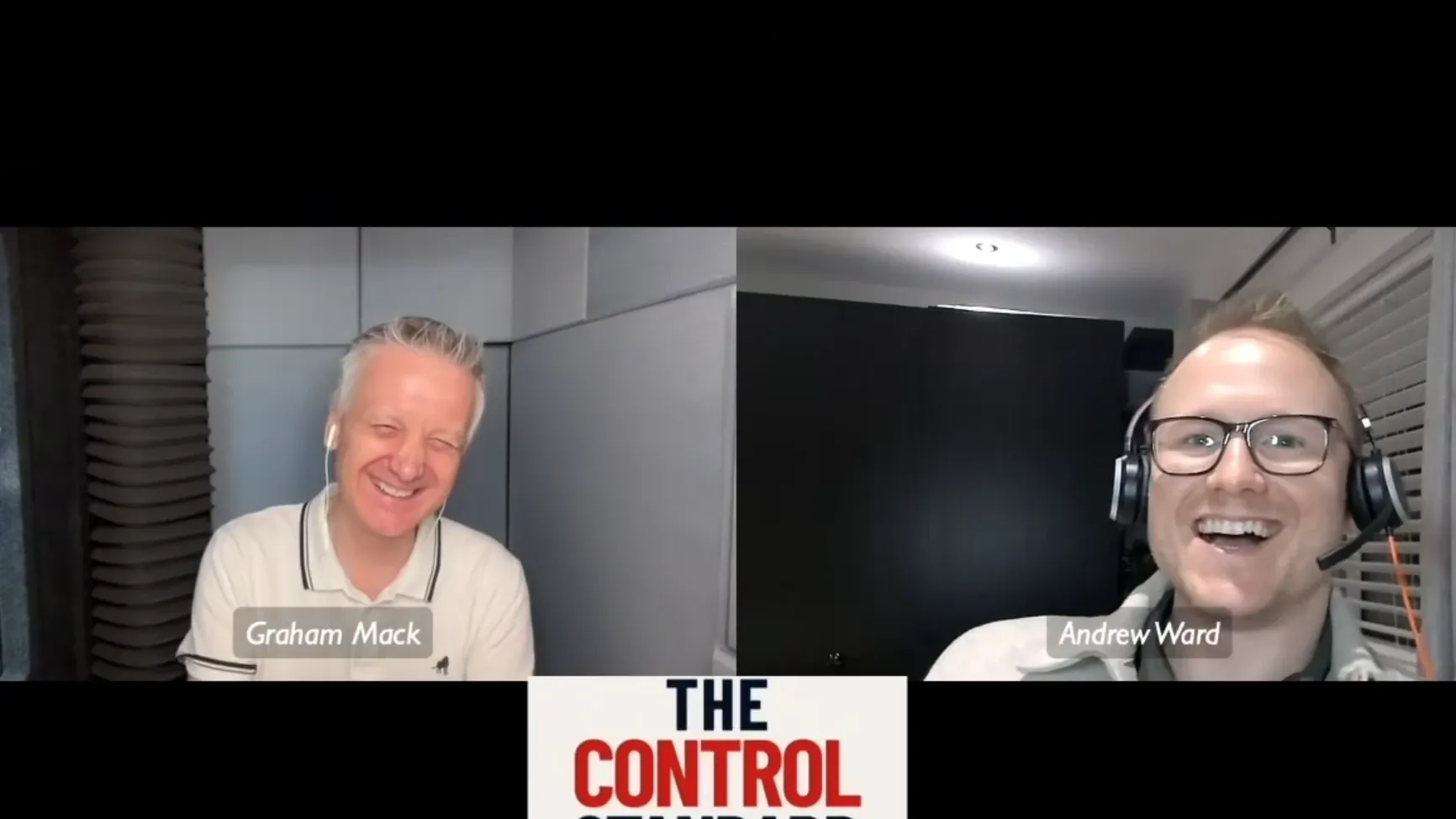
Graham’s interview
Graham records a short video with the authors he narrates for, and he interviewed me about the book. We talked about where it came from and why I wrote it, and swapped stories from his years in radio and mine in software. One thing we agreed on is that this problem turns up in every industry.
One idea from that conversation is worth repeating here. You don’t want to punish bad news. You want to punish surprises. Bad news that arrives early is good, and you should reward it. A late surprise is what you’re really trying to protect against.
The full interview is at the top of this post.
Where to get it
The Control Standard is available in print, ebook and audiobook.
- Book: Amazon UK or Amazon US
- Audiobook: Audible UK, narrated by Graham Mack
- Free tools: controlstandard.tools
You’ll find it alongside my other two books on the books page.
My team at Scorchsoft got it first. I hope it’s as useful to yours. If you read it, try one thing this week: take the piece of work that worries you most and check it has all five control points. Whichever one is missing is where the drift starts.